
Click here to view past issues
IN THIS ISSUE
- WHA Applauds State Legislature for Passing ‘Next-of-Kin’ Legislation, Sending Bill to Governor’s Desk
- Advocacy Day 2026 Photo In-Review
- WHA Hosts 2026 Physician Leadership Development Conference
- WHA and Superior Health Leadership Gain Insight into CMS Quality Priorities at 2026 Conference
- Fast Facts from the WHA Information Center: March is Multiple Sclerosis Awareness Month
EDUCATION EVENTS
Oct. 15, 2026
Substance Use Disorders Management Boot CampOct. 15, 2026
Culture College – Breakthrough Strategies for Creating and Sustaining a Magnetic CultureOct. 20, 2026
WIpop Virtual Training: Session 1Click here to view education event calendar
View more issues of The Valued Voice
Sign Up for WHA's Newsletter


Fast Facts from the WHA Information Center: March is Multiple Sclerosis Awareness Month
For more than 20 years, March has been recognized as Multiple Sclerosis (MS) Awareness Month. According to the National Institutes of Health (NIH), multiple sclerosis is, “an unpredictable disease of the central nervous system disrupting communication between the brain and other parts of the body.” The NIH also states that many believe MS is an autoimmune disease—meaning that the body launches a defense attack against its own cells. 1 in 5 patients are misdiagnosed due to MS symptoms being nonspecific and do not appear the same in every person. In 2019, it was reported that almost one million people in the United States lived with MS.
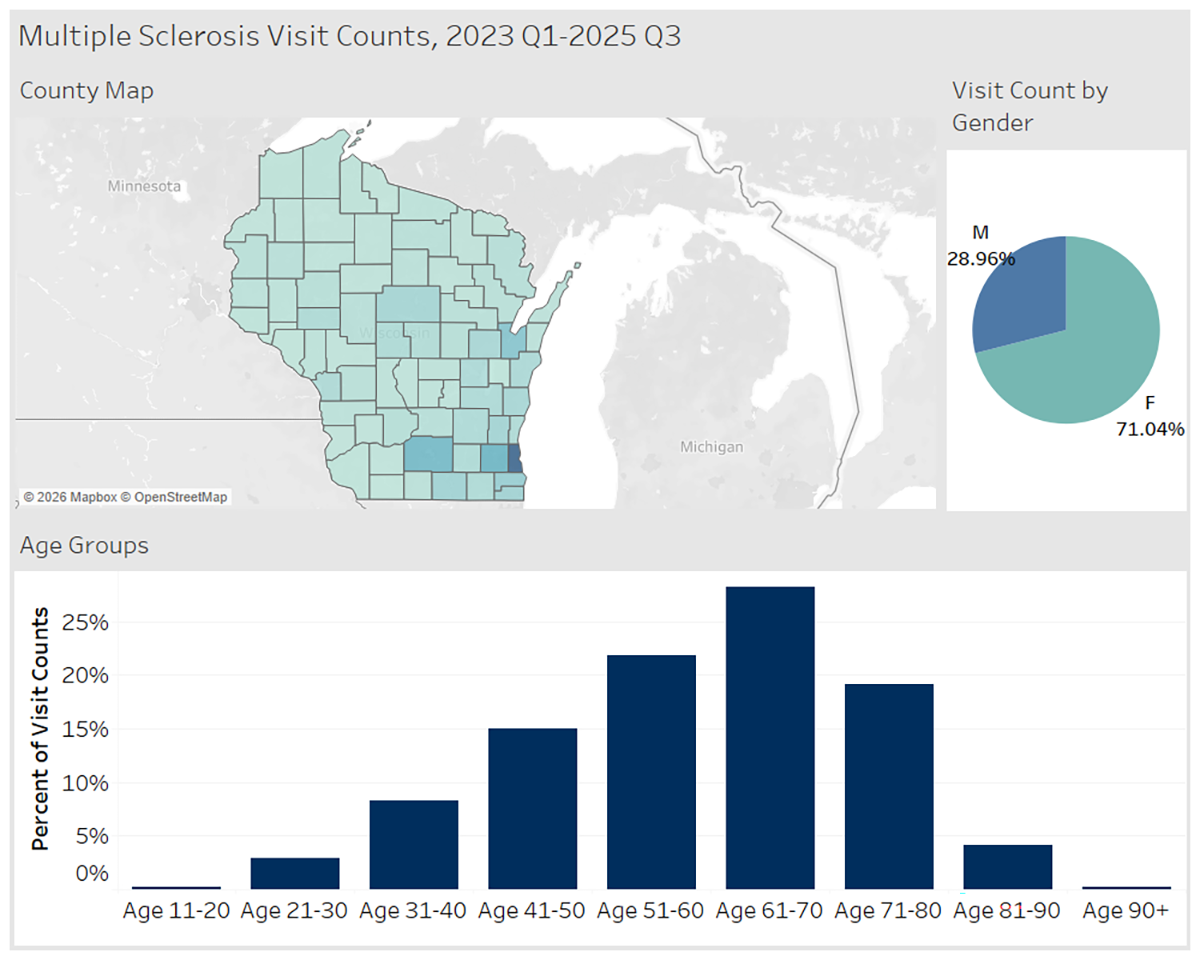
The WHA Information Center analyzed claims for MS from January 2022 to September 2025. The age group with the highest number of visits is 61-70 years old, followed closely by 51-60, with the average age of an MS-related visit being 59 years old. When looking at gender, women account for almost 70% of all MS visits to a hospital, fitting the statistic that women are three times more likely to be affected by the disease.
According to the NIH, most people’s first symptoms appear between the ages of 20-40. Initial symptoms include prickling, or “pins and needles,” double or blurred vision, color distortion for red/green shades or blindness in one eye. Sufferers can also have trouble with balance and coordination, speech impediments, tremors, muscle weakness in extremities and in some cases, partial or complete paralysis. There is currently no cure, but certain medications may help slow and control symptoms.
Risk factors researchers have found that may possibly cause MS:
- Being exposed to certain slow acting viruses like measles, herpes or Epstein-Barr.
- Diets rich in saturated fat intake, as well as deficiencies in fish oil and vitamin D, may increase risk.
- Supporting the correlation between vitamin D deficiency and MS, it has been found that those living closer to the equator are less likely to be affected by MS because of their increased exposure to sunlight.
Fast Facts from the WHA Information Center: March is Multiple Sclerosis Awareness Month
For more than 20 years, March has been recognized as Multiple Sclerosis (MS) Awareness Month. According to the National Institutes of Health (NIH), multiple sclerosis is, “an unpredictable disease of the central nervous system disrupting communication between the brain and other parts of the body.” The NIH also states that many believe MS is an autoimmune disease—meaning that the body launches a defense attack against its own cells. 1 in 5 patients are misdiagnosed due to MS symptoms being nonspecific and do not appear the same in every person. In 2019, it was reported that almost one million people in the United States lived with MS.
The WHA Information Center analyzed claims for MS from January 2022 to September 2025. The age group with the highest number of visits is 61-70 years old, followed closely by 51-60, with the average age of an MS-related visit being 59 years old. When looking at gender, women account for almost 70% of all MS visits to a hospital, fitting the statistic that women are three times more likely to be affected by the disease.
According to the NIH, most people’s first symptoms appear between the ages of 20-40. Initial symptoms include prickling, or “pins and needles,” double or blurred vision, color distortion for red/green shades or blindness in one eye. Sufferers can also have trouble with balance and coordination, speech impediments, tremors, muscle weakness in extremities and in some cases, partial or complete paralysis. There is currently no cure, but certain medications may help slow and control symptoms.
Risk factors researchers have found that may possibly cause MS:
- Being exposed to certain slow acting viruses like measles, herpes or Epstein-Barr.
- Diets rich in saturated fat intake, as well as deficiencies in fish oil and vitamin D, may increase risk.
- Supporting the correlation between vitamin D deficiency and MS, it has been found that those living closer to the equator are less likely to be affected by MS because of their increased exposure to sunlight.
IN THIS ISSUE
- WHA Applauds State Legislature for Passing ‘Next-of-Kin’ Legislation, Sending Bill to Governor’s Desk
- Advocacy Day 2026 Photo In-Review
- WHA Hosts 2026 Physician Leadership Development Conference
- WHA and Superior Health Leadership Gain Insight into CMS Quality Priorities at 2026 Conference
- Fast Facts from the WHA Information Center: March is Multiple Sclerosis Awareness Month
EDUCATION EVENTS
Oct. 15, 2026
Substance Use Disorders Management Boot CampOct. 15, 2026
Culture College – Breakthrough Strategies for Creating and Sustaining a Magnetic CultureOct. 20, 2026
WIpop Virtual Training: Session 1